In the 8th arrondissement, the Museum of Fine Arts of the City of Paris houses fascinating permanent collections, freely accessible in a building constructed at the beginning of the 20th century.
An interview with Annick Lemoine, Director of the Petit Palais.
Annick Lemoine grew up in Paris, where she cultivated a love of art by attending numerous exhibitions. Initially destined for a career in engineering, she turned instead to the study of art history and wrote a thesis on the Caravaggesque painter Nicolas Régnier. From early on, she was driven by a passion for sharing and teaching, at the École du Louvre and the University of Rennes 2. At the same time, she became an exhibition curator, then an advisor to the Minister of Culture, in charge of the democratization of culture from 2009 to 2010.
Her transition from university to museums was spurred by her experience at the Villa Medici in Rome, where she directed the art history department for six years. “I wanted to be closer to the works themselves and also enjoyed working as part of a team,” she says. Later, she became a curator of heritage and took charge of the Musée Cognacq-Jay before being appointed director of the Petit Palais in 2022.
As head of the museum, Annick Lemoine supervises the curators, who study the collections, monitor restorations, and enrich them through new acquisitions. She also determines the display layout of the permanent collection, drives the programming of four annual exhibitions, acts as general curator, and—together with her team—reflects on mediation, that is, on ways to make art accessible to the widest possible audience by offering a fresh perspective.
Built by Charles Girault, the Petit Palais forms, together with the Grand Palais and the Pont Alexandre III, the ensemble conceived for the 1900 Universal Exhibition. Two years later, the City of Paris turned it into a museum of modest scale, whose history has been enriched by generous donations. The Dutuit brothers, both great collectors, bequeathed an exceptional collection of 20,000 works ranging from Antiquity to the Renaissance. They required that admission to the museum be free.
“This tradition has continued,” explains Annick Lemoine, “since artists and their families have always wanted the Petit Palais to be a place of memory—perhaps because of its decor so imbued with artistic gesture.” Thus, Matisse donated Three Bathers by Cézanne to the museum, while Gustave Courbet’s sister gave several of the painter’s works, including Young Ladies by the Seine.
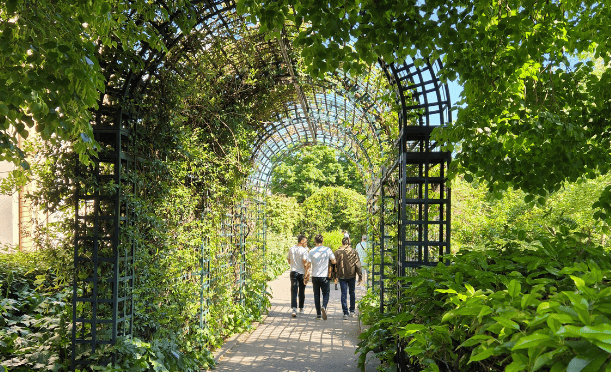
Today, Annick Lemoine’s ambition is to make the institution part of the everyday lives of Parisians—a museum one can visit regularly, whether to admire one of the 1,300 works on display, to discover a temporary exhibition, or simply to have lunch in the peaceful garden planted with exotic trees.